Kindoc
Design Trust under legal constraints
Overview
Medical regulations meant our service had no hospital review feature. But the effect other people's reviews have on purchase decisions was already well established, so I designed around the legal risk to build trust in our checkup products anyway. Reviews on the detail page lifted the funnel through to reservations, and the data they collected became the foundation for a checkup curation feature we built later.
Background
How could I build reviews, our core purchase driver, around legal regulation?
Medical regulations kept us from building a review feature for the 7 years the service had been running. That left me asking: could we build user trust and drive conversion without crossing the legal line?
Typical commerce · Product page
Kindoc · Checkup product page

Project Goal
I mapped how reviews turn into trust, and trust into business results.
I laid out, stage by stage, how a compliant review system could directly move conversion and retention through the process of building user trust.
Research & Insight
I shared early design patterns with stakeholders and gathered their input.
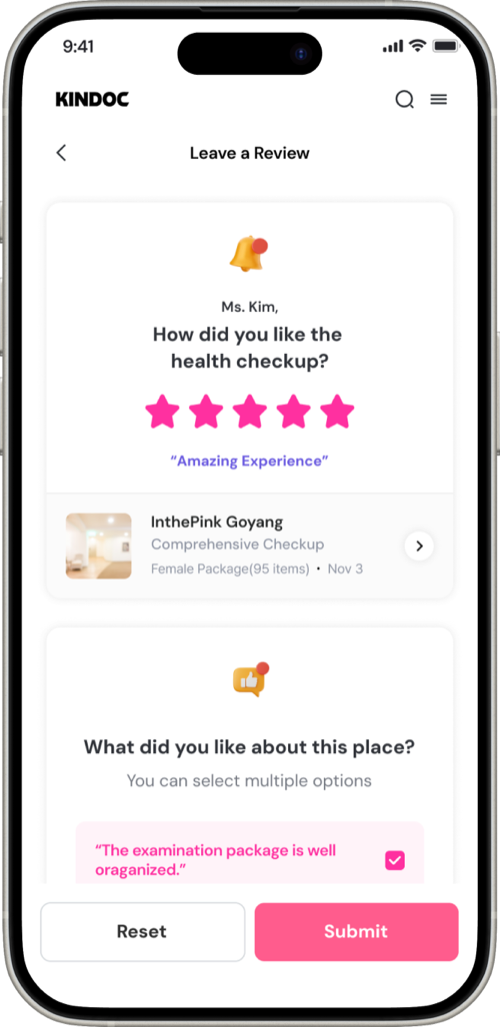
Early in the project, I gave stakeholders (PM, business team) a quick look at a standard review UI. That's when we realized something we'd taken for granted, a plain text-input field, could actually violate medical regulations around hospital promotion in a healthcare context. That conclusion ruled out a generic UI; we needed one built specifically for our service.
Design Process
I found the best flow for collecting and surfacing reviews.
With the review UI and the content we'd collect from users settled through earlier research, the next question was where in the service flow to place the entry point for leaving a review, and where to surface the results.
Where a review is written, and where it is read
- 01 Browse checkups
- 02 Checkup product detail
- 03 Reserve
- 04 Visit · checkup done
- 05 My Info · Reservations
- Entry point to leave a review · 2
- Entry point to read reviews · 1
Design Delivery
I made the entire review-creation process transparent to users.
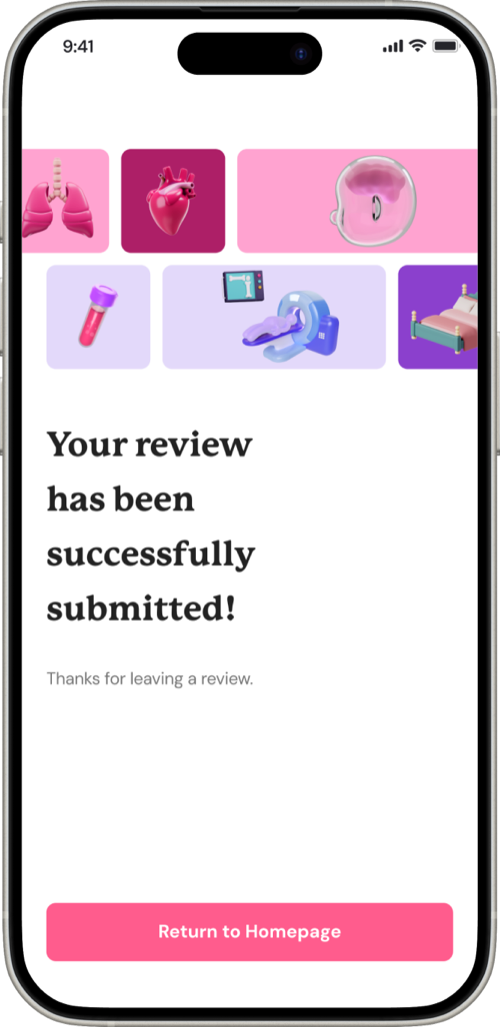
Stakeholders reviewed the design and interaction model and confirmed it was safe from legal risk. The one piece of feedback was to add more information about how reviews are actually created, and I built that into the design.
Design Iteration
Two entry points for leaving a review, one for viewing results.
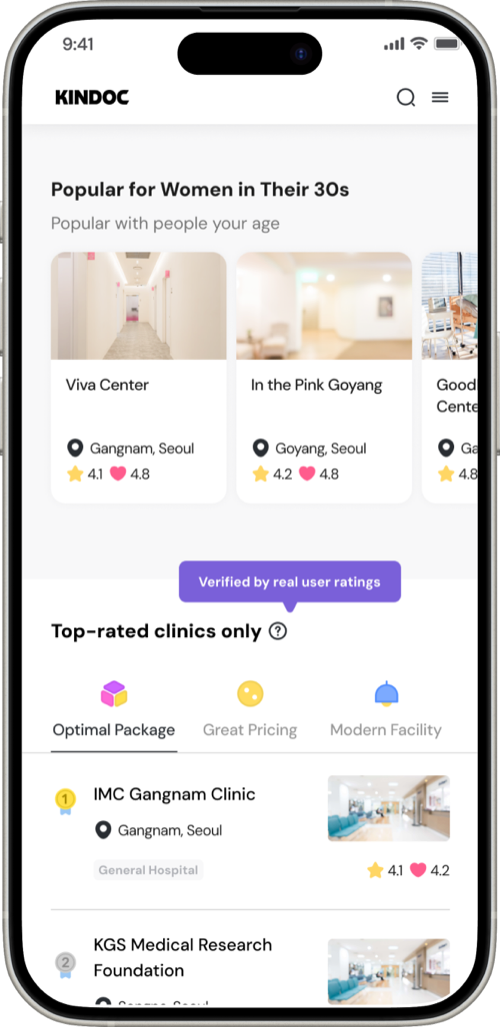
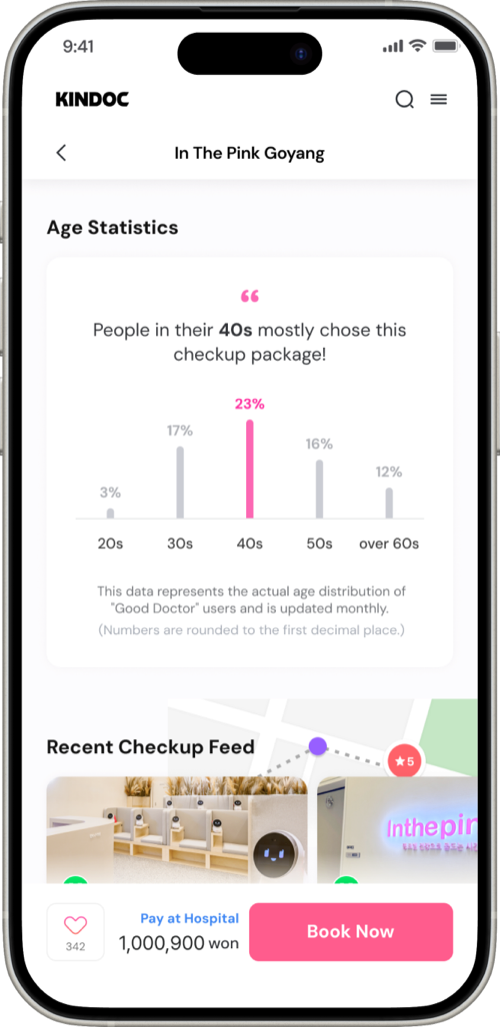
I placed two entry points for leaving a review: at the top of the checkup product detail page, and on the My Info page. For viewing other people's reviews, I placed a single entry point at the bottom of the detail page.
Impact
Lifted purchase conversion, and became the foundation for a new feature.
On the checkup detail page where the review feature lives, the conversion rate through to a completed reservation rose from 70.1% to 73.9% month over month (+3.8pp), and web showed the same upward pattern in the same funnel (58.7% → 61.9%). The structured review data went on to become the foundation for a curation feature that filters centers by age, gender, and popularity.
Achieved a lift in purchase conversion
Detail-page-to-completed-reservation conversion: 70.1% → 73.9% (+3.8pp)
Grew into a new feature
The completion rate among users who started writing a review rose 9.3 percentage points, to 53%. With that many reviews being finished, we built up enough data, and that data became the foundation for the checkup curation feature we built later.
-
APP · Checkup detail
+3.8%p
70.1% 73.9%
conversion through to a completed reservation
-
WEB · Checkup detail
+3.2%p
58.7% 61.9%
same funnel, same upward pattern
-
APP · Rating form
+9.3%
107 117
users who opened the form, month over month
Of the 117 users who opened the rating form, 62 finished it — a 53% completion rate, and enough structured data to build the curation feature on.
Takeaway
Delivering results amid competing stakeholder interests
Designing my way to better business results within medical-law constraints taught me how to balance user trust, legal limits, and business goals, three interests that don't always pull in the same direction. That experience now gives me a reference point for approaching similarly complex, multi-stakeholder situations in the future.